

3Speak - Odysee - BitChute - Rumble - Telegram - YouTube - PDF Notes - Hive Notes - Summary - Sections playlist - MES Links
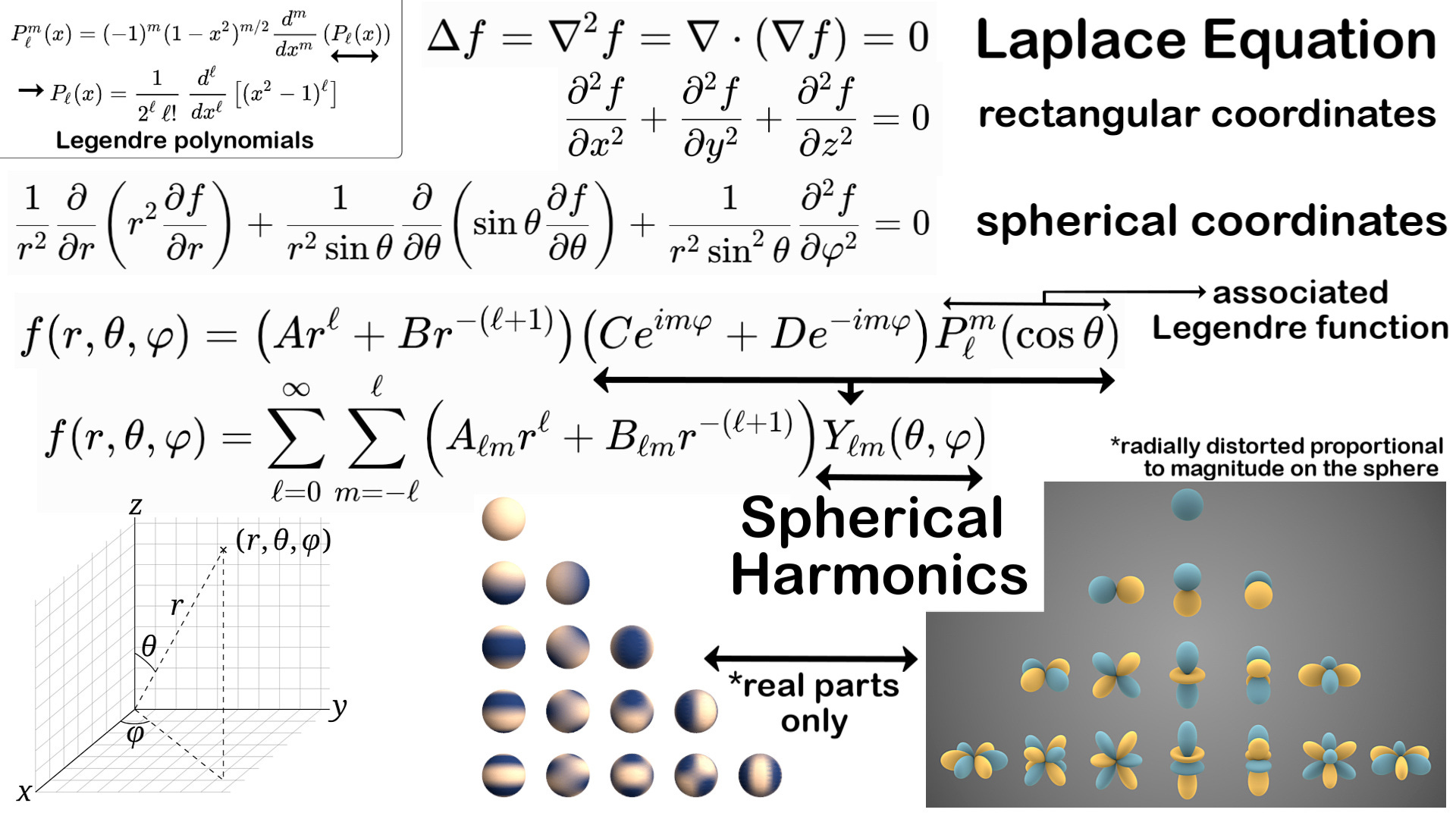
In this video, I go over a deep dive into the famous spherical harmonics, which are the solutions to Laplace’s equation in spherical coordinates and are very prevalent in physics, especially in the quantized configurations of atomic orbitals or the electron charge distribution around the atom's nucleus. Laplace's equation is the sum of the 2nd partial derivatives of a function with respect to the x, y, z terms (in rectangular coordinates) and is equated to zero. Converting this equation into spherical coordinates (r, θ, φ) (which I do by first obtaining the corresponding Laplace operator or Laplacian in polar coordinates), and then solving it produces solutions known as solid spherical harmonics. Focusing only on the angular terms θ and φ obtains the spherical harmonics, which, when plotting only the real terms (ignoring the imaginary terms), and distorting radial terms proportional to the magnitude of values on the sphere, we obtain the distinct 3D lobes!
#math #sphericalharmonics #calculus #atomicorbitals #science
Timestamps
Intro – 0:00
Topics to cover – 0:47
Introduction to Spherical Harmonics – 1:40
Visualization of Real Spherical Harmonics – 25:58
Atomic Orbitals – 31:24
Magnetic Fields – 56:40
Mathematical Review – 1:04:00
Laplace Operator in Polar Coordinates – 1:14:07
Laplace Operator in Spherical Coordinates – 2:09:00
Solid Spherical Harmonics: Solutions to Laplace Equation in Spherical Coordinates – 2:50:38
Associated Legendre Equation – 3:50:00
Spherical Harmonics: Solution to the Angular Laplacian – 4:05:39
Deriving the Real Spherical Harmonics – 4:16:44
Graphing Real Spherical Harmonics in Desmos Calculator – 5:07:41
Outro – 5:19:55


