

3Speak - Telegram - YouTube - Summary- Hive Notes - Sections playlist - MES Links
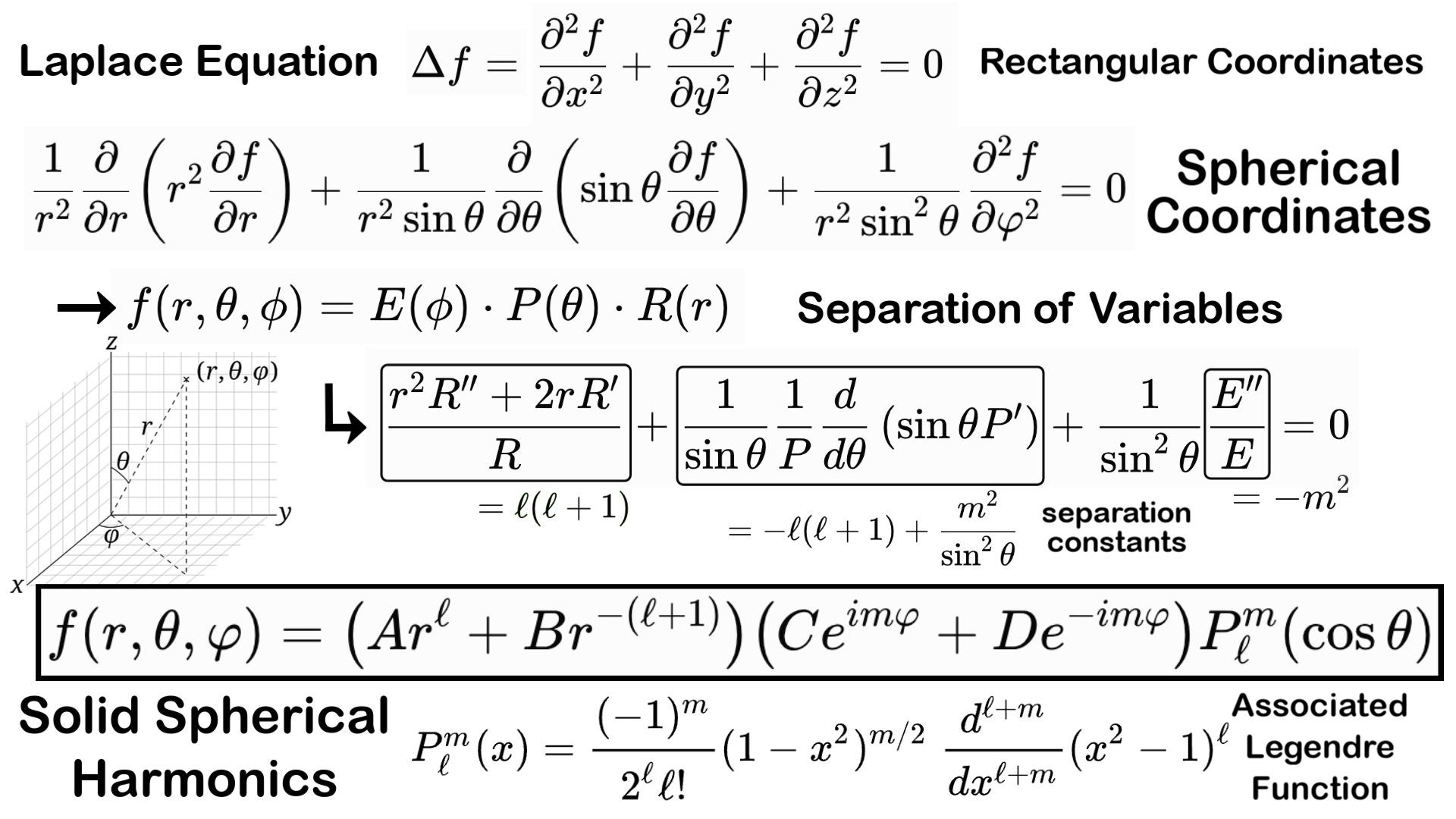
In this video, I go over the derivation of the solid spherical harmonics, which are solutions to the Laplace equation in spherical harmonics. They are referred to as "solid" because they include the radial term as well. I use separation of variables to define a function that is a multiple of 3 separated functions, and then selected separation constants to obtain a periodic, repeating solution. I solve the function corresponding to the azimuthal angle ɸ via the derivative of an exponential function. The function containing the radial r term is the Euler-Cauchy equation, and I solve it via substitution. The middle function is the associated Legendre equation, whose solution is beyond the scope of this video, so I just plugged in the corresponding function. Combining all of these obtains our solid spherical harmonics!
#math #sphericalharmonics #calculus #quantumphysics #laplace
Timestamps
Solid spherical harmonics are the solutions to the Laplace Equation (setting the Laplacian = 0) in spherical harmonics – 00:00
Apply separation of variables and assume the solution is a multiplication of 3 functions –03:50
Set each equation into their corresponding separation constants and ensure a periodic solution – 12:20
The first constant is selected such that the function in terms of ɸ is periodic about 2π radians or 360 degrees – 16:33
The solution of the function with ɸ has complex / imaginary numbers, whose general solution is a linear combination of two basis functions – 21:05
Converting the function to trigonometric form via Euler’s formula – 24:00
The constant negative sign in -m² ensures m is an integer value – 25:53
The second constant is chosen to obtain the Euler-Cauchy equation which I solve via substitution – 33:47
Applying the quadratic equation to obtain two basis solutions – 39:23
The general solution is the linear combination of the two basis solutions – 44:58
The middle equation is the key to spherical harmonics – 49:14
Obtain the associated Legendre equation, whose solution is in terms of the Legendre polynomials via Rodrigues’ formula – 59:14
The derivation of the Legendre polynomials is outside the scope of this video, but see Mike, the Mathematician’s @mikethemathematician playlist https://www.youtube.com/playlist?list=PLLXsDm32L84jhw_OFGVYuKHgLB9yuPTnA – 1:06:36
Obtaining the solid spherical harmonics by putting the solutions to the separated equations together – 1:08:15
Writing out the associated Legendre function in compact form – 1:13:47


