

YouTube - Summary - Notes - Playlist - MES Science playlist
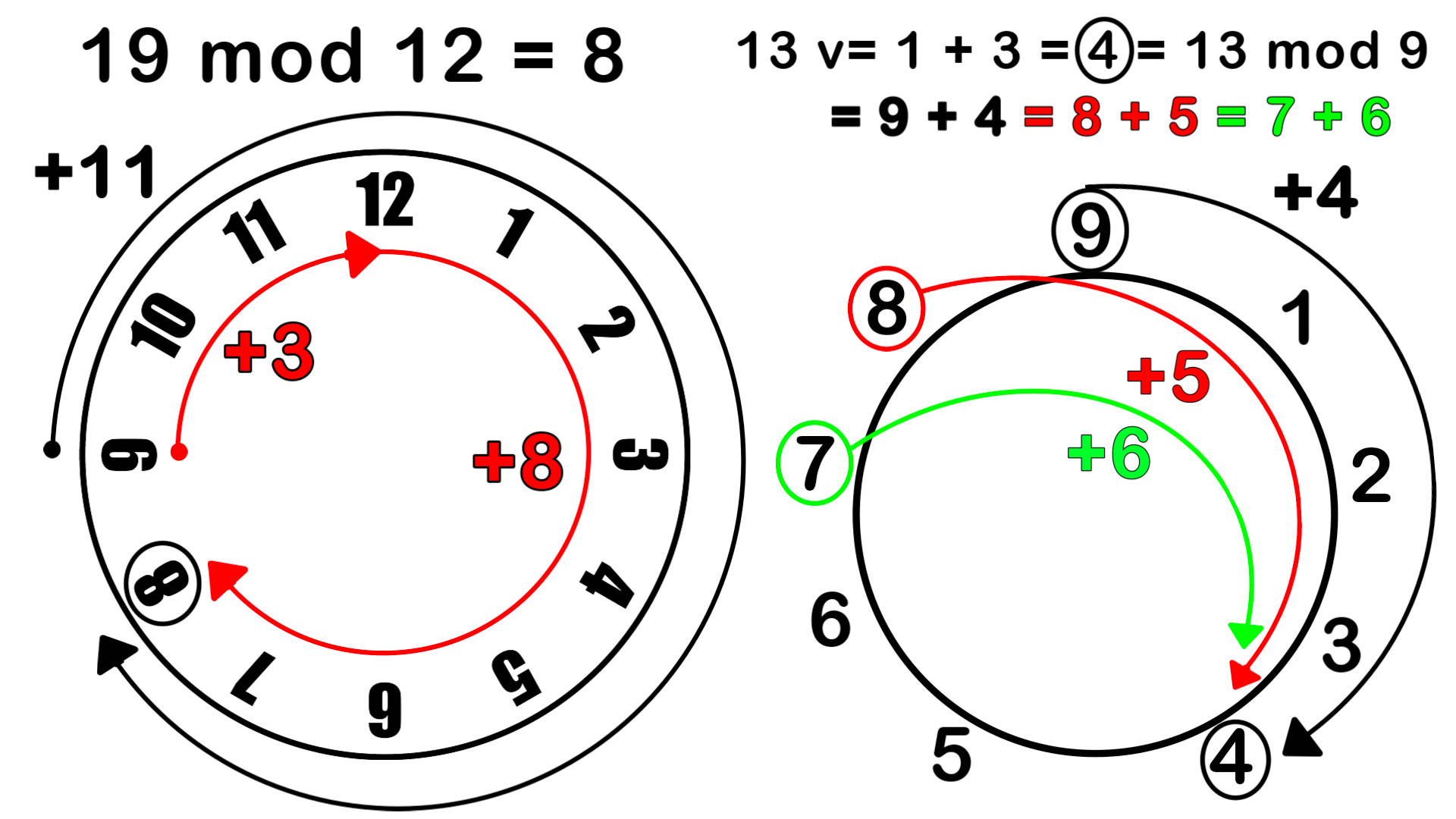
In this video, I go over modular arithmetic and show that it is essentially the same as the “vortex math” that I have been describing. Modular arithmetic is most commonly used in daily life via the 12-hour clock we are accustomed to. 9 hours after 11 p.m. is just 8 a.m., or written in its modulo form as (9 + 11) mod 12 = 8. The modulus is 12 and is the remainder after we sum 9 + 11 = 20 and divide by 12 to get 20/12 = 1 + 8/12, thus 8 is the remainder. And in vortex sum fashion (summing the digits until a single digit is obtained), but first converting to base 13, we get 20 (base 10) = 13 + 7 = 17 (base 13) v= 1 + 7 = 8. Note that we converted to base 13 because the vortex sum is equal to the modulus of the (base - 1) aka (13 - 1 = 12), which equates to 20 mod 12 = 8.
For typical base 10 vortex sum, the modulus is 9. Visually, we can graph out a clock with 9 at the top and obtain the vortex sum, remainder, and modulo 9 of any number!
#math #vortexmath #modulararithmetic #numbertheory #education
Timestamps
Modular arithmetic: Clock has modulus 12 – 0:00
Base 10 has modulus 9 for vortex sum – 2:30
Factors of 9 get wrapped completely around the circle – 3:22
All integers are reduced regardless of size to 1 digit – 4:48


