

3Speak - YouTube - Telegram - Notes - Playlist - Sequences and Series - MES Links
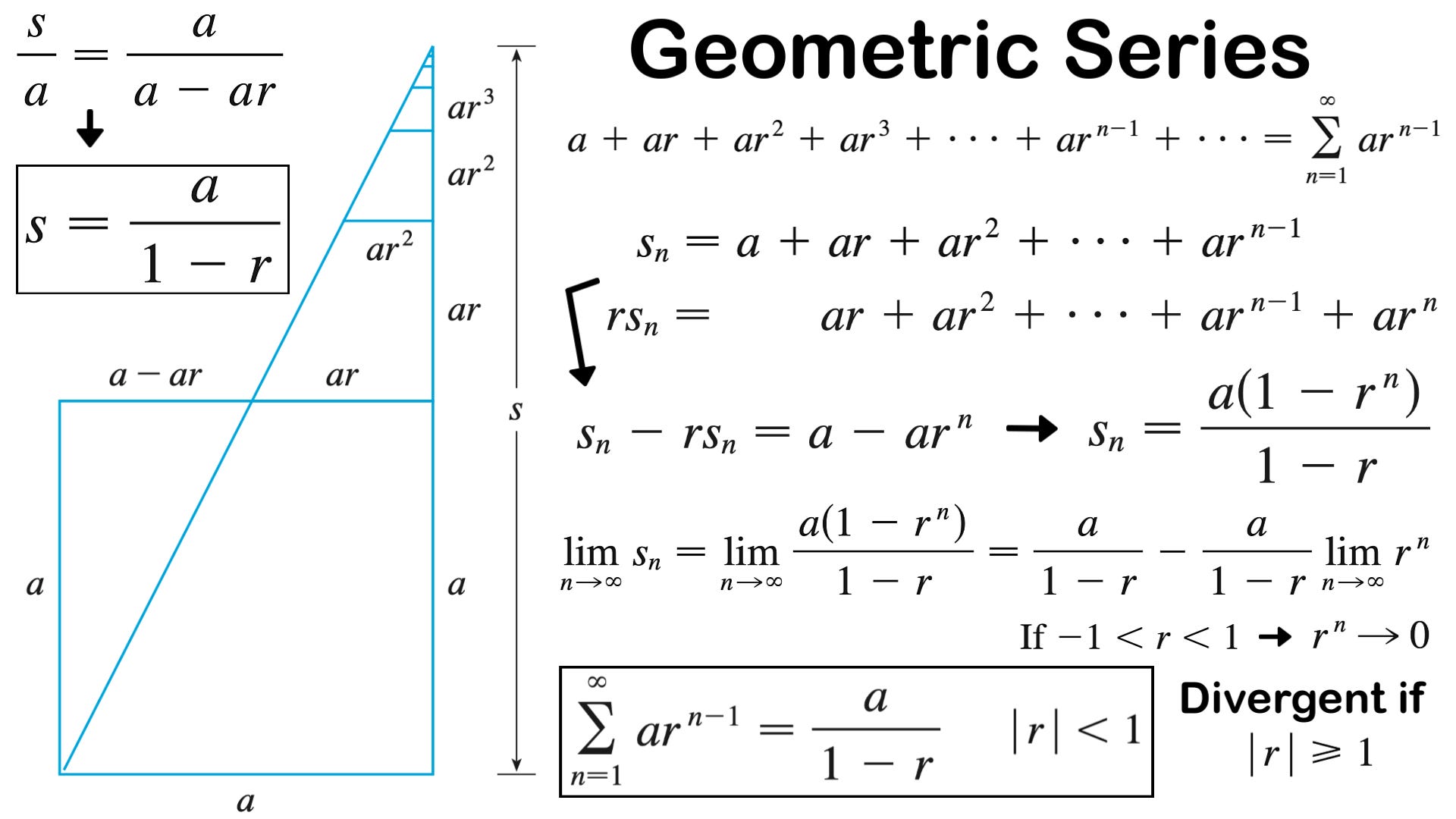
In this video, I go over the geometric series, which is the sum a + a r + a r^2 + ..., and show that if the absolute value of the common ratio r is less than 1, then the sum is just the first term divided by one minus the common ratio. I first derive this formula by a very simple yet genius method of multiplying the infinite series by r, and then subtracting the resulting series and rearranging to solve for the sum. I also illustrate this geometrically via similar triangles. For all other values of r, the series is divergent, hence does not exist.
#math #calculus #series #geometricseries #education
Timestamps
Example 1: Geometric series multiplies previous term by common ratio r – 0:00
If r = 1, then the series diverges – 2:07
If r ≠ 1, then we can obtain a formula for the sum of the series using an ingenious method of multiplying by r – 2:58
If r is between -1 and 1, then the series r^n converges to zero – 5:53
Sum of geometric series for this case is just the first term divided by (1 - r) – 7:30
If |r| is greater than 1, then the geometric series is divergent – 8:24
Summary of Geometric Series – 9:09
Geometric demonstration of the geometric series using similar triangles – 10:33
Obtain the same formula: Sum = first term divided by common ratio – 14:05


